White Lines and Quiet Hierarchy: A Morning in the Venue Car Park
Anyone who tells you a tour day begins at the get-in is lying. It begins about forty minutes earlier, at the mouth of a one-way system, when the sat-nav says you have arrived and all you can see is a height-restriction bar, a wheelie bin on its side and a sign that says NO PARKING AT ANY TIME in letters large enough to be read from space.
The car park is the first conversation of the day. It is also the one nobody puts on the call sheet. Get it right and the morning hums along. Get it wrong and you spend the next nine hours apologising to a man called Dave from estates who has a clipboard and absolutely no interest in your artistic vision.
The first arrival sets the weather
There is a strange truth about venues: the mood of the day is usually decided by whoever gets there first. Not the tour manager, not the production manager, not the person with the laminated risk assessment. The first arrival. If they arrive calm, find a sensible spot and put the kettle on, everyone else walks into a warm room. If they arrive to find a locked barrier, a code that no longer works and a van wedged under a fire exit, that tension follows the whole crew around like a smell.
So the first job is not unloading. The first job is reconnaissance. Walk the perimeter. Find the loading bay. Find the stage door. Find out whether the barrier opens with a fob, a code, a phone call or a hopeful wave at a camera. Find the bin store, because at some point someone will need it, and find the spot where the ground is firm enough to take a van without turning into a brown puddle by lunchtime.
Loading-bay etiquette is a language
A loading bay is not just a rectangle of tarmac. It is a social contract written in faded yellow paint. The rules are rarely displayed, but they are enforced with a look.
- Do not block the bay while you go and find someone. Someone will always need it in the next three minutes.
- Do not assume the bay is yours because it is empty. It is empty for a reason, and that reason is usually a delivery due at nine.
- If a venue has one bay and two shows, the day is going to be interesting. Be the reasonable one early, because you will need that goodwill later.
- Never, under any circumstances, park across the fire exit. Not even for a minute. Not even if the stage door is right there and you are only dropping off one bag. That is the one rule that turns a friendly greeting into a formal conversation.
In the UK, the loading bay often doubles as a bin store, a smoking area, a shortcut for staff and, on wet days, a small inland sea. Treat it like a shared kitchen: clean up after yourself, do not take the last of anything, and never leave your gear in the way of the kettle.
Tour-van Tetris and the art of the sensible no
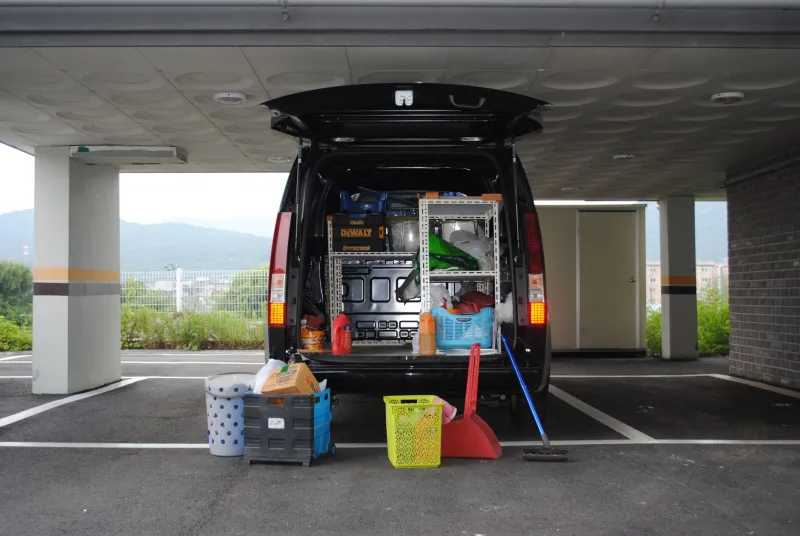
The tour van is a puzzle box with a wheel at each corner. By the time you have loaded it for the fifth time in a week, you have opinions about which case goes where that you did not know you were capable of. The car park is where those opinions become public.
There is a moment, usually around 8:40am, when someone suggests moving the van 'just a bit closer' to the stage door. This is the moment to be brave and say no. A van six feet closer saves you ninety seconds of walking and costs you a wing mirror, a shouted conversation with a traffic warden and a dent in the day's goodwill. The sensible no is one of the great backstage skills. It belongs in the kit bag next to the gaffer tape.
If you are in a multi-vehicle convoy, agree the order before you arrive. Nobody wants to watch a transit, a splitter van and a car belonging to someone's uncle perform a three-point turn in a market town square while a delivery driver waits with his indicator on.
The space by the stage door
Every venue has one. The space closest to the door. It is not marked as special, but everyone knows. It is the one that lets you carry a guitar case twenty feet instead of two hundred. It is the one that keeps you dry when the rain comes sideways. It is the one that, on a long day, means you can nip out for a coffee without losing your parking spot to a stranger in a Nissan Micra.
The hierarchy is quiet but real. The headliner usually gets it, unless the headliner is not in yet, in which case the crew gets it, unless the crew is not in yet, in which case the person with the most fragile equipment gets it, unless that person has already parked somewhere else and now feels oddly slighted. Nobody ever discusses this. It is negotiated through eye contact, reversing lights and the phrase 'are you alright there?'
Council rules, pay-and-display and the RingGo gamble
Outside London, the car park is often run by the council with a level of enthusiasm usually reserved for bin collections. Pay-and-display machines will be either broken, full of leaves or mysteriously free. The RingGo app will ask you to create an account you will never use again. The signs will contradict each other in a way that suggests they were designed by committee and installed by someone in a hurry.
Practical advice: photograph the sign. Screenshot the payment. Note the bay number. If a warden appears, you want to be the person with evidence and a pleasant expression, not the person arguing about a faded double yellow while holding a roll of gaffer tape. And if the venue says they will validate your parking, get that in writing. A nod from a door person is not validation. It is a hope.
Weather, ground and the long walk back
In November, a car park is a test of character. Gravel holds water. Puddles hide potholes. The walk from the far corner to the stage door is long enough to make you question your choice of footwear. Seagulls in coastal towns regard the bonnet of a tour van as a personal challenge. In cathedral cities, the parking is medieval and the cobbles are unforgiving.
So pack for the walk, not the drive. Keep a spare pair of socks in the cab. Keep a torch in the door pocket. Keep the number for the venue in your phone under something memorable, because at 11pm you will not remember what you saved it as.
The last space and the first impression
The car park is not glamorous. It does not appear in the programme. Nobody will ever ask you about it at the merch table. But it sets the tone for everything that follows. A calm arrival makes a calm get-in. A calm get-in makes a good soundcheck. A good soundcheck makes a show that feels easy, even when it is not.
So when you find that last space by the stage door, take it with good grace. Park straight. Leave room for the next van. And if someone else gets there first, let it go. There will be another car park tomorrow, another set of white lines and another quiet hierarchy to navigate. The trick is to arrive as the sort of person people are glad to see, even before you have picked up a single case.