The Book on the Ledge: Signatures, Scrawls and a Stage Door's Long Memory
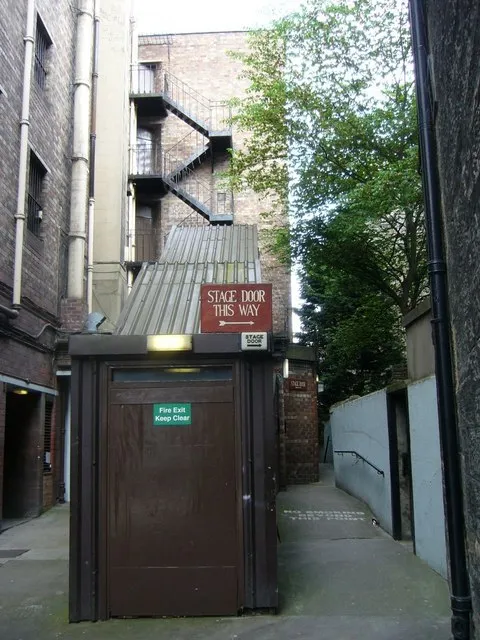
Photo: kim traynor, CC BY-SA 2.0, via Wikimedia Commons
The first thing you notice is the pen. It's a biro on a length of garden twine, knotted through a hole punched in the corner of the cover, and the twine has gone slightly furry where years of thumbs have worried at it. The book itself is an A4 hardback ledger, the kind you'd have bought from a stationery shop that closed down a decade ago. The spine is reinforced with two strips of black gaffer tape. Somebody has written LEDGER on the front in marker, and somebody else has written the venue's name underneath in a different, smaller hand, as though correcting the record.
The book lives on a ledge just inside the stage door, below the bell that doesn't work and above the box of disposable earplugs nobody refills. It is not the signing-in book. That one is clipped to a board on the wall, all printed columns and fire regulations, and it exists because insurers like to know who is inside a building at any given moment. The ledger on the ledge exists for no reason at all, which is precisely why it's worth writing about.
Two Books, Two Jobs
One is a legal document. The other is a habit. The signing-in sheet gets a time, a name, sometimes a signature so rushed it looks like a heart monitor. The ledger gets whatever the person at the door feels like leaving: a name, a doodle, a joke, an apology for the state of the van, a small message to the building itself.
I've been going through that stage door on and off for years, in various capacities — carrying a bag, holding a door, once, memorably, arriving with a bag of ice at half past eleven at night because somebody's knee had gone. And in all that time I have never once seen anyone asked to sign the ledger. There's no instruction. Nobody stands over you. You see the book, you see the pen, and you work out the rest yourself. That's the whole system.
Who Actually Signs
The obvious answer is visiting companies, and they do: the whole cast of a touring play in one evening, the panto ensemble in a great rush before the matinee, a dance troupe whose names are all in cursive. But the ledger is more interesting than that.
There's the courier who brings the costume boxes up from the depot in Crewe, who signs with a single initial and a time, because a time is what he deals in. There's the bloke who services the boiler, who wrote 'all done, parts on order' across three lines and drew an arrow. There's the chaperone who signs every week during a panto run and has started numbering her entries, as if she's keeping score. There's the rep from the hire company, the woman who reupholsters the front-of-house seats, the electrician who came in for a fault and stayed for a brew.
And then there are the first-timers. You can spot them from the doorway. They arrive early, they hover, they check their phone, they check the door, they check their phone again. Then they see the book. And something in them relaxes, because here's a job they can do.
How a Person Signs
Backstage handwriting is its own small science. A company manager will sign with a quick, confident loop, the same signature they've used on a thousand delivery notes. A drummer will do initials only, because initials are faster. A deputy stage manager will print, neatly, in small caps, because a DSM who signs in a hurry is a DSM who has not yet had their coffee and everyone knows what happens next.
Then you get the ones who draw. A cat, quite a good one, in biro, dated last spring. A small cartoon of a lighting bar. A crudely rendered pint. Somebody has written 'SORRY ABOUT THE NOISE' in enormous letters, and underneath, in different ink, 'IT WAS LOVELY NOISE'. Nobody knows which show that was. Nobody needs to.
The messages are the best bit. 'Good luck, all.' 'Back soon, I hope.' 'Third time here, still can't find the toilet.' 'Thanks for the tea, sorry for the language.' One entry, from a Tuesday in November, reads simply: 'Lovely building. Be kind to it.'
The Dave Entries
My favourite entries are the ones that have nothing to do with performance at all. Halfway through the book there's a page with three lines of biro: 'Dave. B&Q. 2pm. Light fittings.' That's it. No date, no fuss. But because the book dates itself by position rather than design, you can work out roughly when Dave came, and what was going on in the building that week, and whether the fittings in question are the ones still buzzing faintly in the corridor by the offices.
This is the part people miss about a ledger like this. It isn't a roll call of the famous. It's a record of attendance, and attendance includes the plumber, the delivery driver, the person from the council who came to look at the damp patch, and the teenager from the local paper who was sent to photograph the panto cow. The building is a company of everyone who has ever turned up for it, and the book is the only place that says so.
The Ceremony of the First Time
I once watched a young performer — first professional job, first venue, bag over one shoulder, lanyard already on — stand at that ledge for a good thirty seconds before picking up the pen. She wrote her name, then her role in brackets, then thought better of it and drew a small star. Then she looked around to see if anyone had noticed. I pretended not to have.
That's the quiet power of the thing. Signing a fire sheet is admin. Signing the ledger is a small ceremony of arrival. It says: I was here, and I'd like that noted, and I'd like to be the sort of person who is noted. Nobody teaches you to do it. You just see the book, and the twine, and the pen, and you understand the assignment.
What the Book Can't Hold
The ledger is not a proper archive and it knows it. Pages are missing — one torn out cleanly, presumably for a phone number, another ripped halfway and abandoned. There's a coffee ring on the cover that has been there so long it has its own patina. The pen runs out roughly every three months and is replaced by whoever notices first, which means the book has been signed in blue, black, and for one memorable fortnight, a green gel pen that smudged on everything.
It is not indexed. It is not searchable. Nobody has ever digitised it, and I hope nobody ever does, because a scanned ledger is just a file, and the point of the ledger is that it's a thing you can hold.
The Ledge
The stage door book doesn't flatter anyone. It will not tell you who was brilliant or who was difficult, who sold out or who played to forty people on a wet Tuesday. It only says: you came through the door, and you wrote something down, and the building kept it.
If you're ever in a venue and you see a battered hardback on a ledge with a biro on a bit of string, do the decent thing. Sign it. Put the date. Draw something. You're part of the company now, whether you're on the call sheet or just delivering the light fittings.